2002 / 2002tii / 2002 Turbo
1968-1976 / Sedan / Germany
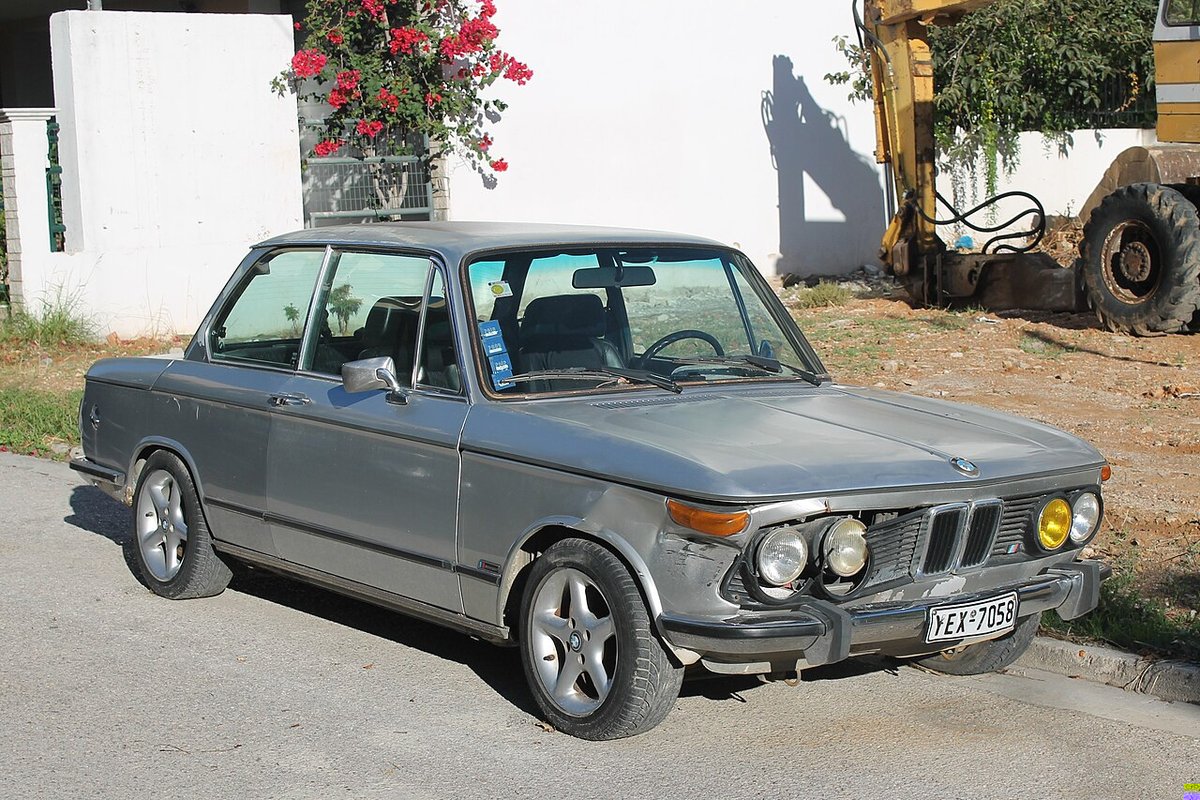
Photo: Charlie from United Kingdom / Wikimedia Commons CC BY 2.0
The BMW 2002 arrived in 1968 as the company's answer to the question of what happens when you put a bigger engine in a smaller car. Based on the 1600, this compact sedan received a 2.0-liter four-cylinder that transformed it from practical family transport into something genuinely thrilling. It became the template for the modern sports sedan, a concept BMW would refine for decades. The 2002tii, introduced in 1971, added fuel injection and a Sportomat semi-automatic gearbox to the already potent formula, while the 1973 2002 Turbo represented one of the world's first turbocharged production cars, though it arrived with conservative tuning that belied its potential.
In Australia, the 2002 became a fixture on race circuits and rally stages throughout the 1970s, earning respect from drivers who understood that compact size and willing horsepower made for better racing than sheer displacement. The model developed a devoted following among enthusiasts who appreciated its honest engineering and straightforward driving experience. Club racing and historic events continue to celebrate these cars, and they remain surprisingly affordable entry points into classic BMW ownership, which has only increased their appeal in the local scene.
What makes the 2002 series genuinely important is its influence on automotive design philosophy. Here was a car that proved you didn't need massive cylinders or flashy styling to create something memorable, just sound engineering, predictable handling, and enough power to make drivers smile. These are the cars that reminded the industry that smaller could be better, and they've aged remarkably well because of that fundamental honesty.
Thinking of buying a 2002 / 2002tii / 2002 Turbo?
What to look for, what to pay, what to avoid.
What to watch for.
Timing Chain Tensioner Wear
Critical Engine, M10 (All Models)
Timing Chain Tensioner Wear
CriticalA rattling or slapping noise from the front of the engine on cold start, which may quieten as oil pressure builds. In severe cases, the rattle persists when warm. If ignored, the chain can skip a tooth, altering valve timing and potentially causing valve-to-piston contact.
The M10's timing chain tensioner is a spring-loaded, oil-pressure-assisted device. The spring weakens with age, and the tensioner body wears against the chain guide. As the tensioner loses effectiveness, the chain develops slack.
Replace the timing chain tensioner. On high-mileage engines (200,000+ km), replace the chain and guides as well, a stretched chain on a new tensioner won't solve the problem. Cost: $150-300 for tensioner only, $400-700 for chain, guides, and tensioner.
Oil Leaks, The M10 Weeps From Everywhere
Critical Engine, M10 (All Models)
Oil Leaks, The M10 Weeps From Everywhere
CriticalOil residue on the engine block, oil drips on the garage floor, burning oil smell from the exhaust manifold. Common leak points: rocker cover gasket, oil pan gasket, rear main seal, timing chain cover gasket, distributor shaft seal.
Cork and rubber gaskets degrade over 50 years. The M10 uses a mix of gasket materials, and all of them fail with age. Crankcase pressure from worn valve guides or a failed breather system accelerates seal failure.
Reseal the engine systematically. Replace all gaskets and seals in one session rather than chasing individual leaks. The rocker cover gasket is the easiest, a $20 gasket and 30 minutes of work. The rear main seal requires gearbox removal. A full reseal: $300-600 DIY, $800-1,500 at a workshop.
Overheating
Minor Engine, M10 (All Models)
Overheating
MinorTemperature gauge climbs into the red zone, particularly in slow traffic or on hot days. Coolant may boil over. Persistent overheating causes head gasket failure and head warping.
The M10's cooling system was designed for German weather, not Australian summers. The original radiator loses capacity as internal passages corrode. The thermostat sticks. The water pump impeller corrodes. Electric fan switches fail. Many 2002s have had their cooling systems neglected for decades.
Upgrade the radiator to a larger-capacity aluminium unit ($300-500). Replace the thermostat (make sure it opens at the correct temperature, 80°C). Replace the water pump if it has any play. Ensure the electric fan operates correctly. Consider an additional electric fan for cars driven in traffic. Total cooling system refresh: $400-800.
Valve Clearance Drift
Common Engine, M10 (All Models)
Valve Clearance Drift
CommonTicking noise from the valve train that changes with engine temperature. Loss of power and rough running if clearances become too large or too small.
The M10 uses solid lifters (no hydraulic self-adjustment). Valve clearances change as the valve seats wear and the valve stems stretch. This is normal maintenance, not a defect, but many owners skip it.
Adjust valve clearances to specification using feeler gauges. This is a 30-minute job requiring a valve cover removal, feeler gauge set, and a 10mm spanner. Check every 20,000 km. Cost: $0 DIY (plus $20 for a feeler gauge set), $100-200 at a workshop.
Carburettor Wear and Maladjustment
Common Fuel System, Carburettor (Base 2002)
Carburettor Wear and Maladjustment
CommonPoor idle quality, hesitation on acceleration, rich running (black exhaust smoke, fuel smell), lean running (backfiring, overheating), poor fuel economy.
The Solex 40 PDSI or Weber 32/36 DGV carburettor has numerous wear points: throttle shaft bushings develop play (causing air leaks), jets wear, float valves stick, diaphragms perish, and gaskets shrink. Ethanol in modern fuel attacks old carburettor materials.
Rebuild the carburettor using a quality rebuild kit. This replaces all gaskets, seals, needle valves, and accelerator pump diaphragms. Inspect the throttle shaft bushings, if worn, the carburettor body needs bushing (specialist work). Cost: $60-120 for a rebuild kit, $200-400 for a specialist rebuild.
Fuel Pump Failure
Common Fuel System, Carburettor (Base 2002)
Fuel Pump Failure
CommonEngine stumbles or dies under load, particularly at high RPM or when the fuel tank is below half. Fuel starvation symptoms.
The mechanical fuel pump, driven off the camshaft, uses a rubber diaphragm that perishes with age. The check valves also wear. Modern ethanol-blended fuel accelerates deterioration of the rubber components.
Replace the fuel pump with a new unit or rebuild with an ethanol-resistant diaphragm kit. Cost: $60-150 for a new pump.
Join the conversation.
Common questions.
What is the BMW 2002?
The BMW 2002 is a two-door compact sedan produced from 1968 to 1976. The name breaks down simply: "20" for the 02 Series body, "02" for the 2.
What is the difference between a roundie and a squarie?
The terms refer to the taillight shape, which changed during a mid-production facelift: **Roundie (1968-1973):** Round taillights, chrome bumpers, cleaner rear design. The "classic" 2002 look.
What is the Kugelfischer fuel injection on the tii?
The Kugelfischer PL04 is a purely mechanical fuel injection system, no electronics whatsoever. It uses a pump driven by the engine that meters fuel through a complex arrangement of cams, plungers, and diaphragms.
Is the 2002tii worth the extra money over the base car?
It depends on your priorities. The tii is a meaningfully better car to drive, the extra 30 horsepower, crisper throttle response, and better economy make it feel more complete.
Own a 2002 / 2002tii / 2002 Turbo?
Share your car with the community. explore more BMW models.