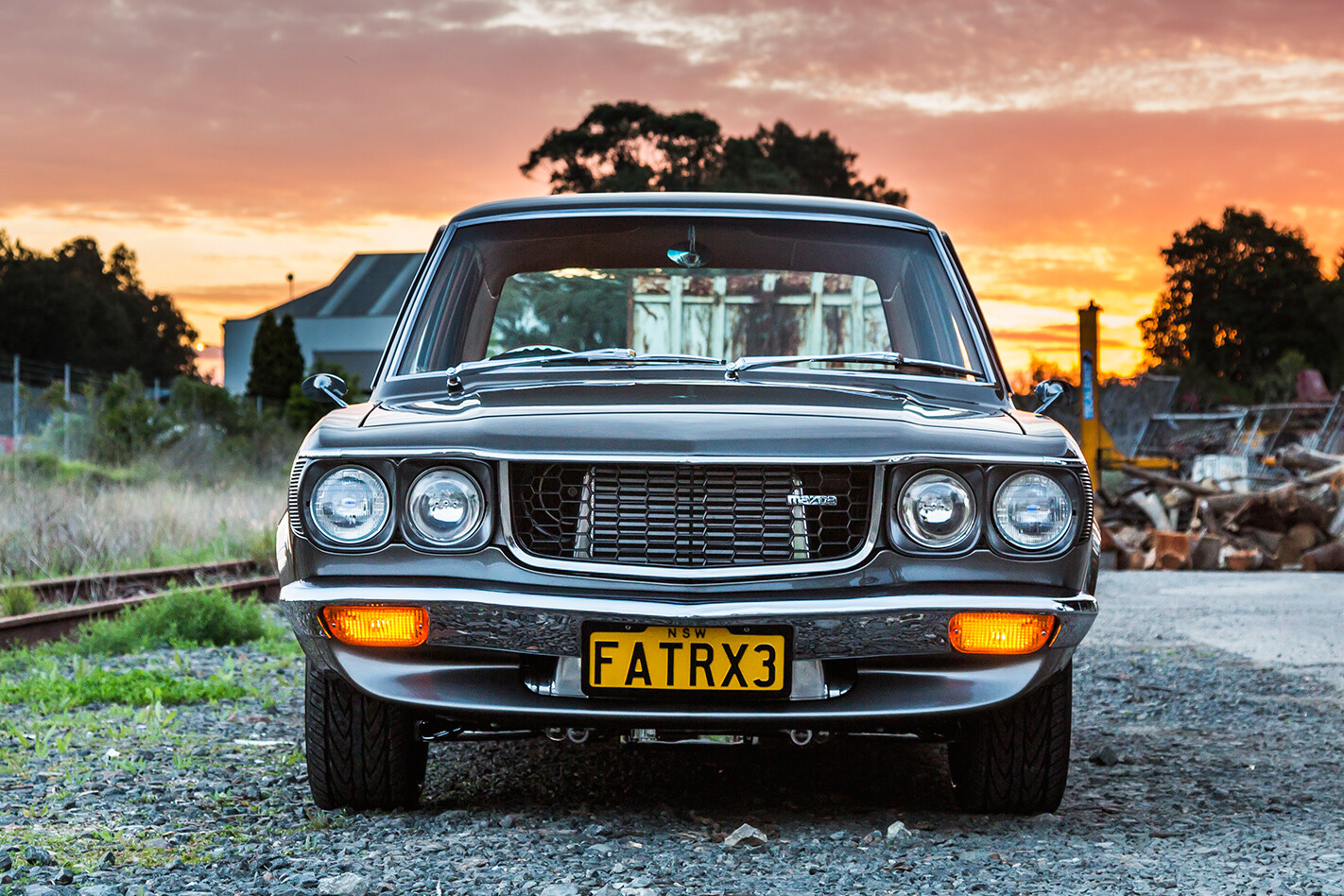
RX-3 (Savanna)
1971-1978 / Coupe / Sedan / Estate / Japan
The RX-3 terrorised the Australian touring car scene in the early 1970s, winning Bathurst in 1975 and proving that the rotary engine was not just novel but genuinely competitive at the highest level. Its light weight and high-revving 12A engine made it a giant-killer against much larger V8 Falcons and Toranas, earning it a devoted following among Australian motorsport fans.
The coupe is the most desirable body style, with clean examples now commanding serious collector prices that rival European sports cars. The RX-3's racing heritage gives it a cachet that few Japanese cars can match in Australia. Even the sedan and wagon variants have their followers, though the coupe is the icon. Finding an original, unmodified RX-3 is extremely difficult, as most have been modified for racing or had engine swaps over the decades. A genuine 12A-powered coupe in good condition is a significant find.
Thinking of buying a RX-3 (Savanna)?
What to look for, what to pay, what to avoid.
What to watch for.
Apex Seal Wear and Failure
Minor Engine, Rotary-Specific Issues
Apex Seal Wear and Failure
MinorGradual loss of compression, reduced power output, difficulty starting (especially when hot), increased oil consumption, and eventually the engine won't sustain combustion. In catastrophic failure, a broken apex seal fragment can score the rotor housing surface, requiring housing replacement.
The apex seals are the equivalent of piston rings, they maintain the gas-tight seal between the rotor faces and the epitrochoid-shaped housing. Every rotation, the apex seals sweep across the housing surface under spring tension and combustion pressure. Over tens of thousands of rotations, the seal material wears down. The rate of wear depends on lubrication (oil metering pump function and pre-mixing), operating temperature, combustion temperature, and carbon deposit buildup.
Full engine strip and rebuild. The engine is removed, disassembled, and all seals (apex seals, side seals, corner seals, oil seals) are replaced. The rotor housings are inspected and resurfaced or replaced if scored. The rotors themselves are inspected for wear. A quality rebuild costs $2,500-4,000 for the 12A and includes all seals, bearings, and gaskets. The 10A is slightly less due to smaller components but parts are scarcer.
Rotor Housing Scoring
Minor Engine, Rotary-Specific Issues
Rotor Housing Scoring
MinorDeep scratches or grooves in the chrome or Nikasil coating of the rotor housing inner surface. Reduces compression even with new apex seals. Visible during engine disassembly.
Foreign material passing through the engine (debris from a failed apex seal, carbon chunks, detonation fragments), running the engine with inadequate lubrication, or severe overheating that warps the housing and allows metal-to-metal contact.
Mild scoring can sometimes be polished out. Severe scoring requires rotor housing replacement. Used housings in good condition run $300-800 each. New housings (when available) are $600-1,200 each. The 12A uses two rotor housings.
Oil Metering Pump Failure
Common Engine, Rotary-Specific Issues
Oil Metering Pump Failure
CommonThe engine receives insufficient oil for apex seal lubrication. The apex seals run dry, wear accelerates dramatically, and catastrophic engine failure follows. There may be no warning, the engine simply starts losing compression faster than normal.
The oil metering pump (OMP) is a mechanical pump driven by the eccentric shaft that injects metered quantities of engine oil onto the rotor housing surfaces. The pump can fail mechanically (worn internals, broken drive), the oil lines can crack or block, or the pump calibration can drift with age.
Two approaches. Conservative: rebuild or replace the OMP, check all oil lines, and verify function. Cost: $200-400. Aggressive (and increasingly common): delete the OMP entirely and rely solely on pre-mixing two-stroke oil with the fuel at a 1:150 to 1:200 ratio. This provides more consistent lubrication and eliminates the OMP as a failure point. Many rotary specialists recommend premix-only operation.
Coolant Seal (O-ring) Failure
Critical Engine, Rotary-Specific Issues
Coolant Seal (O-ring) Failure
CriticalCoolant leaks into the combustion chamber (white smoke from exhaust, coolant loss without external leak) or coolant leaks externally from the engine block mating surfaces. The engine overheats.
The rubber O-rings that seal the coolant passages between the rotor housings and the side housings (end plates) harden and lose their sealing ability with age and heat cycling. This is an age-related failure, the O-rings eventually go regardless of maintenance.
Engine must be disassembled to replace the O-rings. Since the engine is apart, a full seal kit and rebuild is standard practice. Cost: $2,500-4,000 including all seals.
Carbon Buildup
Minor Engine, Rotary-Specific Issues
Carbon Buildup
MinorHard carbon deposits accumulate on the rotor faces, apex seal grooves, and exhaust ports. The deposits restrict apex seal movement in their grooves, causing the seals to stick and lose their spring tension against the housing. Compression drops, power decreases, and the engine runs rough.
Short trips where the engine never reaches full operating temperature, low-rpm driving (the rotary needs revs to stay clean), and poor fuel quality all contribute to carbon buildup. The rotary engine is particularly susceptible because the combustion chamber shape and seal arrangement create areas where deposits accumulate.
Prevention is key, drive the car hard regularly, use quality fuel, and keep the engine at operating temperature. For established deposits, an "Italian tune-up" (sustained high-rpm driving) can clear some buildup. Severe cases require engine disassembly and manual cleaning. Some owners use decarbonising additives, but these are controversial in the rotary community.
Inner Guard Corrosion
Minor Rust
Inner Guard Corrosion
MinorThe front inner guards corrode from trapped mud, moisture, and road debris. Rust perforates the inner guard panels, weakening the structural support for the front suspension mounts.
The inner guard design traps debris and moisture in areas with poor drainage. Factory corrosion protection on 1970s Japanese cars was minimal. Decades of accumulated grime holds moisture against the metal.
Mild surface rust: wire brush, rust converter, and protective coating. Perforation: cut and weld repair panels. No reproduction inner guards are available, all repair work is custom fabrication. Cost: $1,000-3,000 per side for professional fabrication and welding.
Join the conversation.
Common questions.
What is a rotary engine and how does it work?
The rotary (Wankel) engine uses a triangular rotor that orbits inside an epitrochoid-shaped housing. Each of the rotor's three faces creates a combustion chamber that cycles through intake, compression, combustion, and exhaust as the rotor rotates.
Should I pre-mix two-stroke oil in my RX-3?
Yes. Pre-mixing is considered best practice by the vast majority of experienced rotary owners and engine builders.
How do I perform a compression test on a rotary engine?
Use a standard automotive compression tester, but the procedure differs from a piston engine. Warm the engine to full operating temperature first, cold readings are misleading on a rotary.
What is an apex seal and why does it matter?
The apex seal is a strip of material (typically cast iron or carbon composite) positioned at each apex (corner) of the triangular rotor. There are three apex seals per rotor, six in a twin-rotor engine.
RX-3 (Savanna) owners.
Own a RX-3 (Savanna)?
Share your car with the community. explore more Mazda models.