E36 3-Series
1990-2000 / Sedan / Coupe / Convertible / Estate / Germany
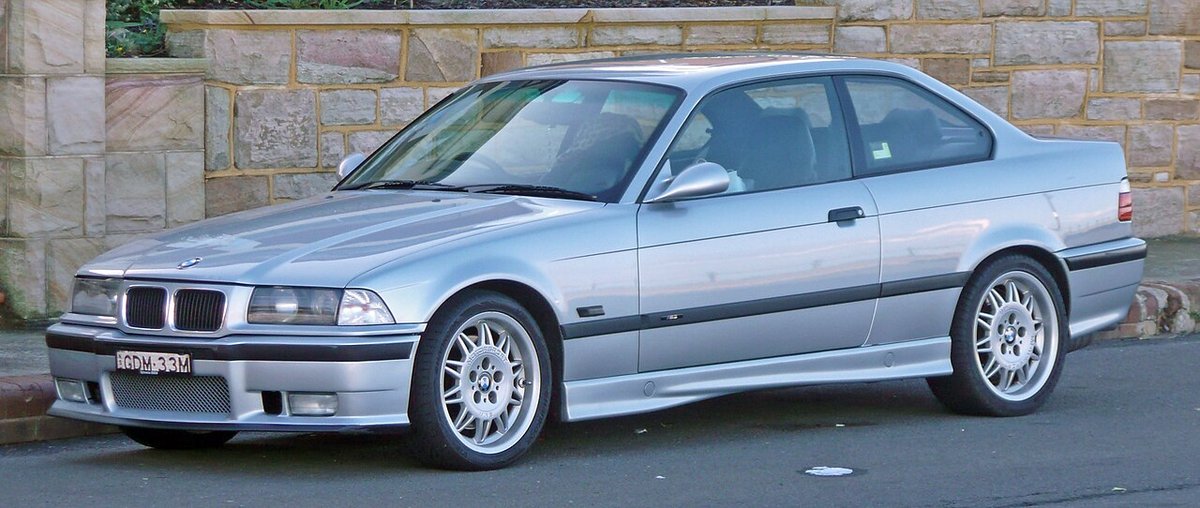
The E36 3-Series represents BMW at a pivotal moment, bridging the gap between the beloved E30 and the modern era. Launched in 1990, this third generation 3-Series refined everything the Munich marque had learned about building compact, driver-focused saloons. It brought independent suspension geometry, improved safety standards, and a more spacious interior while maintaining the essential character that made the 3-Series a benchmark for the class. The E36 was offered in multiple body styles, sedan, coupe, convertible, and estate, each finding its audience among enthusiasts who valued handling, build quality, and that particular German engineering ethos.
In Australia, the E36 quickly became a fixture on roads and racetracks alike. The local Touring Car Championship saw fierce competition from E36-based machinery throughout the 1990s, and the model's balance of performance and usability made it popular with everyday drivers who appreciated a proper driver's car. The M3 variant, in particular, achieved legendary status here, with its 3.0-litre inline-six becoming the subject of considerable enthusiasm in club circles and at trackdays. It's a car that rewards involvement from the driver, whether you're threading through a canyon road or extracting every last bit from that creamy engine.
Today, the E36 occupies a special place in the classic car community. It's modern enough to be daily-drivable and simple enough that owners can actually work on them, yet old enough now to carry genuine nostalgia. The best examples represent some of the finest compact sports sedans ever built, and they've earned their place in the hearts of Australian enthusiasts who grew up watching them dominate the touring car grid.
Thinking of buying a E36 3-Series?
What to look for, what to pay, what to avoid.
What to watch for.
VANOS Seal Failure
Common Engine, M50/M52 (320i, 325i, 328i)
VANOS Seal Failure
CommonRattling or clattering noise from the front of the engine on cold start, lasting 10-30 seconds before fading as oil pressure builds. Loss of low-end torque, the engine feels flat below 3,000 rpm and only comes alive higher in the rev range. In severe cases, rough idle and a general feeling that the engine is "lazy" at low speeds.
The VANOS unit (Variable Nockenwellensteuerung, variable camshaft timing) uses rubber O-ring seals that harden and shrink with age and heat exposure. When the seals lose their ability to maintain oil pressure within the VANOS unit, the camshaft timing actuator can't hold position at low oil pressure (cold start) and loses its ability to advance the intake cam timing at low RPM.
Rebuild the VANOS unit with new seals. VANOS rebuild kits are available from Beisan Systems and other specialists for $50-100. The VANOS unit is accessible from the front of the engine (remove the valve cover and the VANOS cover). The rebuild takes 2-4 hours for a competent DIY mechanic. Alternatively, a BMW specialist can rebuild it for $200-500 including parts and labour.
Cooling System Failure, Expansion Tank
Critical Engine, M50/M52 (320i, 325i, 328i)
Cooling System Failure, Expansion Tank
CriticalThe plastic expansion tank cracks, often along a moulding seam or at the neck where the cap seals. Coolant pours out rapidly. The engine overheats within minutes if the driver doesn't notice the temperature gauge climbing.
The expansion tank is made of glass-fibre-reinforced nylon that becomes brittle after years of thermal cycling and exposure to pressurised, hot coolant. The material degrades from the inside out, so the tank may look fine externally while being on the verge of failure. BMW acknowledged the issue and revised the tank design multiple times, but all plastic tanks eventually fail.
Replace the expansion tank proactively. Do not wait for it to fail on the road. If the tank is original or more than 5 years old, replace it. Check for yellowing, surface cracking, or any discolouration, these are signs of impending failure. Cost: $40-80. Replace the cap at the same time ($15-25).
Cooling System Failure, Water Pump
Critical Engine, M50/M52 (320i, 325i, 328i)
Cooling System Failure, Water Pump
CriticalEngine temperature gradually rises above normal, or suddenly overheats. Coolant leak from the water pump area. In some cases, no external symptoms, the plastic impeller simply disintegrates inside the pump housing, and broken plastic fragments circulate through the cooling system, blocking the heater core and radiator passages.
The factory water pump uses a plastic impeller mounted on a metal shaft. The plastic degrades from coolant exposure and heat, and the impeller vanes crack or separate entirely from the hub. The bearing also wears, allowing the shaft to wobble and the seal to leak.
Replace with a metal-impeller water pump. The Stewart Components pump and the Graf metal-impeller pump are the most recommended. Always replace the thermostat and coolant at the same time. If the old pump's impeller was broken, flush the cooling system thoroughly to remove plastic fragments. Cost: $120-250 for a quality pump.
Cooling System Failure, Thermostat Housing
Common Engine, M50/M52 (320i, 325i, 328i)
Cooling System Failure, Thermostat Housing
CommonCoolant leak from the thermostat housing area. The leak may be slow (seeping at the gasket) or sudden (the plastic housing cracks).
The factory thermostat housing is plastic. Like the expansion tank, it becomes brittle with age. The bleed screw boss is a common cracking point. Overtightening the bleed screw accelerates failure.
Replace with an aftermarket aluminium thermostat housing. These are permanent replacements that eliminate the plastic failure mode. Cost: $50-100 for an aluminium housing. Include a new thermostat ($30-50) and gasket.
Oil Leaks
Critical Engine, M50/M52 (320i, 325i, 328i)
Oil Leaks
CriticalOil weeping or dripping from the valve cover gasket, oil filter housing gasket, oil pan gasket, VANOS oil line seals, and front crank seal. A high-mileage M50 or M52 will have oil residue on most external surfaces.
Rubber and cork gaskets degrade over decades. The valve cover gasket is the most common, the rubber hardens, shrinks, and stops sealing. The oil filter housing gasket (a large O-ring) is the most critical, oil drips onto the hot exhaust manifold.
Replace gaskets systematically. The valve cover gasket is easiest ($30-60 in parts, 1 hour labour). The oil filter housing gasket requires removing the intake manifold on some models ($20 for the gasket, 2-3 hours). The oil pan gasket requires dropping the front subframe on some models, not a quick job. Cost for a full reseal: $300-600 DIY, $800-1,500 at a workshop.
M52 Nikasil Bore Wear (Early M52 Only)
Common Engine, M50/M52 (320i, 325i, 328i)
M52 Nikasil Bore Wear (Early M52 Only)
CommonDifficult cold starting, rough running, misfiring, loss of compression. Cylinder leak-down test shows excessive leakage past the piston rings.
Early M52 engines (approximately 1996-1998) used Nikasil bore lining, a nickel-silicon carbide coating applied directly to the aluminium block. In regions with high-sulphur fuel, sulphuric acid in the combustion byproducts attacks the Nikasil lining, causing it to deteriorate. Compression loss follows. Australian fuel is relatively low in sulphur, so this is less common here than in the UK or parts of the US, but it does occur, particularly on imported cars that may have spent time in high-sulphur regions.
If the Nikasil lining is significantly deteriorated, the block needs to be bored and fitted with steel liners ($2,000-3,000). Later M52 engines (M52TU, 1998 onwards) used Alusil bore technology, which is not affected by this issue. Before buying an early M52, perform a compression and leak-down test.
Join the conversation.
Common questions.
What is the BMW E36?
The E36 is BMW's third-generation 3-Series, produced from 1990 to 2000. It was sold as a four-door sedan, two-door coupe, convertible, Touring (wagon, not in Australia), and compact (hatchback).
What is the best E36 engine?
For enthusiasts, it's between the M50B25 (325i) and the M52B28 (328i). The M50B25 has an iron block (stronger, heavier), VANOS, and produces 141 kW.
What is VANOS and why does it matter?
VANOS (Variable Nockenwellensteuerung) is BMW's variable camshaft timing system. On the M50TU and M52, it varies the intake cam timing based on engine speed and load.
What is the rear subframe cracking issue?
The E36's rear subframe is bolted to the unibody through mounting points in the boot floor. Under sustained high loads, hard cornering, hard braking, track use, or just decades of Australian roads, the sheet metal around these mounting points develops fatigue cracks.
Own a E36 3-Series?
Share your car with the community. explore more BMW models.