Torana (LJ-LX) / GTR / SLR / A9X
1972-1979 / Coupe / Sedan / Hatchback / Australia
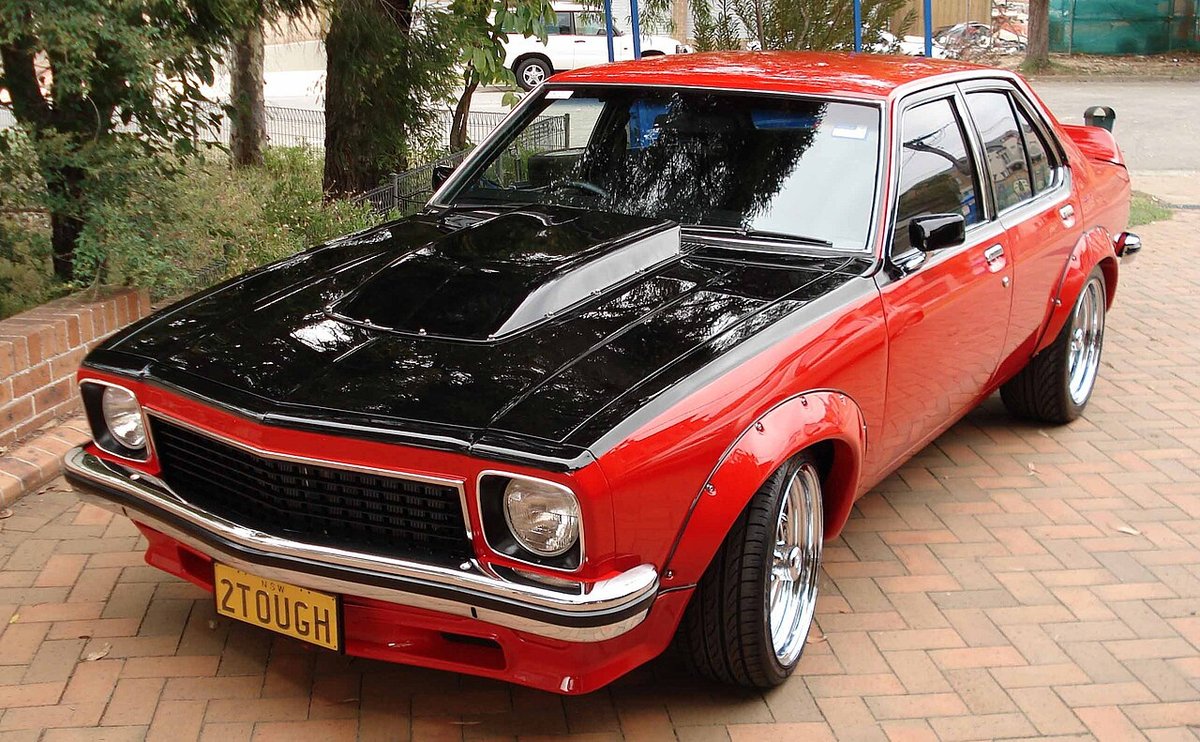
Photo: The original uploader was 2tough at English Wikipedia. / Wikimedia Commons Public domain
The Holden Torana represents one of Australia's greatest automotive achievements, a genuinely quick family car that proved local engineers could build something special without relying on imported platforms. Born from the LC model in 1972, the Torana evolved through the LJ and LX generations with increasing sophistication, offering buyers genuine performance wrapped in practical family transport. The GTR and SLR variants brought serious credentials to the compact segment, while the legendary A9X homologation special turned the Torana into a genuine race car for the road, dominating Australian touring car racing in the late 1970s with a potent 5.0L V8 that made over 300 horsepower.
What made the Torana special was its honest engineering and Australian racing pedigree. From Peter Brock's legendary Bathurst performances to club racing fields across the country, the Torana proved that you didn't need European sophistication to build a driver's car. The combination of light weight, responsive handling, and increasing engine options created a genuine enthusiast's machine that was affordable and attainable. The A9X particularly captured the imagination of Australian petrolheads, offering superb aerodynamics, a race-bred engine, and unbridled performance that made it the car to have.
Today, the Torana holds a sacred place in Australian automotive culture. Whether it's the early LC models with modest power or the fire-breathing A9X, these cars represent a golden era when Holden was truly thinking local and building world-class competitors. They remain hugely popular in the classic car scene, valued equally by restoration enthusiasts and track day competitors who appreciate their mechanical simplicity, parts availability, and genuine performance credentials.
Thinking of buying a Torana (LJ-LX) / GTR / SLR / A9X?
What to look for, what to pay, what to avoid.
What to watch for.
Worn Bearings and Low Oil Pressure
Common Engine, Holden Six (173ci / 202ci)
Worn Bearings and Low Oil Pressure
CommonOil pressure drops below 25 psi at idle when hot. Knocking from the bottom end under load.
The main and big-end bearings wear over 50+ years. The oil pump also wears, reducing delivery pressure. Infrequent oil changes accelerate bearing wear.
Bottom-end rebuild, new bearings, check and potentially regrind the crank. Budget $1,500-2,500 at a machine shop. The Holden six is one of the simplest engines in the world to rebuild, it's a straightforward, honest motor that rewards basic maintenance.
Triple Carburettor Synchronisation (XU-1)
Common Engine, Holden Six (173ci / 202ci)
Triple Carburettor Synchronisation (XU-1)
CommonRough idle, uneven running, flat spots, poor throttle response. The engine feels rough and unbalanced.
The GTR XU-1's triple Stromberg carburettors must be precisely synchronised, all three must deliver the same airflow at the same throttle opening. Over time, the individual carburettors wear at different rates, the linkage develops play, and the synchronisation drifts. Modern fuel with ethanol also attacks the original rubber components in the carburettors.
Rebuild all three carburettors with quality kits ($150-300 total), then synchronise using a vacuum gauge or Unisyn tool. Each carburettor's idle mixture, idle speed, and throttle linkage must be adjusted individually, then balanced against the others. This is a skilled job, if you're not experienced with multiple carburettor setups, find a specialist. Budget $300-500 for a professional rebuild and synchronisation.
Valve Stem Seal Deterioration
Minor Engine, Holden Six (173ci / 202ci)
Valve Stem Seal Deterioration
MinorBlue smoke on startup that clears within a minute. May also smoke briefly on deceleration.
The rubber valve stem seals harden and crack with age. Oil seeps past the valve stems into the combustion chambers.
Replace the valve stem seals. Can be done with the head in situ using compressed air to hold the valves up. Budget $50-100 for a seal kit.
Overheating in the Compact Engine Bay
Critical Engine, Holden V8 (253ci / 308ci)
Overheating in the Compact Engine Bay
CriticalTemperature gauge climbs in traffic or under sustained load. May push coolant out the overflow. Engine pings (detonation) under acceleration.
The 253 and 308 V8 engines generate significantly more heat than the six-cylinder they replaced in the Torana's engine bay. The engine bay was originally designed for the six, and while the LH/LX were adapted for the V8, the cooling system clearances are tighter than in the larger HQ/HJ/HX sedans. The factory radiator is often marginal, particularly in the 308. Hot exhaust manifolds radiate heat into the confined space, and the thermostat housing is close to the carburettor, causing fuel vaporisation (vapour lock) in extreme conditions.
Upgrade the radiator to a 3-core brass or aluminium unit ($400-800). Fit an electric thermo fan behind the radiator ($150-250) to improve low-speed cooling. Wrap or ceramic-coat the exhaust manifolds to reduce underbonnet heat. Ensure the thermostat is the correct 82°C rating. Check the water pump for leaks and impeller erosion. Consider an insulating gasket between the carburettor and intake manifold to reduce vapour lock.
Rochester Quadrajet Carburettor Problems
Common Engine, Holden V8 (253ci / 308ci)
Rochester Quadrajet Carburettor Problems
CommonHesitation off idle (the classic "Q-jet bog"), flooding, hard starting when hot, black smoke, fuel smell.
The Q-jet's primary metering system is sensitive to wear. The accelerator pump fails, the power piston sticks, the float level drifts, and the needle valve leaks. Modern ethanol-blended fuel attacks old rubber components.
Rebuild with a quality rebuild kit ($80-150). Pay particular attention to the float level, an incorrect float level causes 90% of Q-jet running problems. Alternatively, replace with a Holley 4-barrel or Edelbrock Performer carburettor ($400-800) for simpler tuning and better parts availability.
Valve Train Noise (308 V8)
Common Engine, Holden V8 (253ci / 308ci)
Valve Train Noise (308 V8)
CommonTicking or clattering from the top of the engine. May vary with RPM.
The 308's shaft-mounted rocker arms wear at the tips and the shaft develops scoring. The pushrod tips can also cup. This is accelerated by infrequent valve adjustments and oil that's too thin.
Inspect and replace worn components. A Yella Terra roller rocker conversion ($400-800) is the definitive fix, it eliminates the wear mechanism entirely and frees up a small amount of power by reducing friction.
Join the conversation.
Common questions.
What's the difference between the LJ, LH, and LX?
The LJ (1972-1974) continued the earlier LC Torana's body style with a revised front end and carried the six-cylinder GTR XU-1 performance legacy. The LH (1974-1976) was a completely redesigned car, longer, wider, and more modern, and was the first Torana to offer V8 engines (253ci and 308ci).
What was the GTR XU-1?
The GTR XU-1 was the performance variant of the LC and LJ Torana. "XU-1" stands for "eXperimental Utility, number 1", Holden's internal project designation.
What is the A9X?
The A9X is a homologation special, a limited-production Torana built to qualify the car for Group C touring car racing. Approximately 405 were produced in 1977 (split between sedans and hatchbacks).
How do I verify an A9X is genuine?
At A9X prices, authentication is absolutely critical. Every genuine A9X has a specific VIN structure, body number, and option codes that identify it from the factory.
Own a Torana (LJ-LX) / GTR / SLR / A9X?
Share your car with the community. explore more Holden models.