Falcon (XK-XP)
1960-1966 / Sedan / Convertible / Estate / Australia
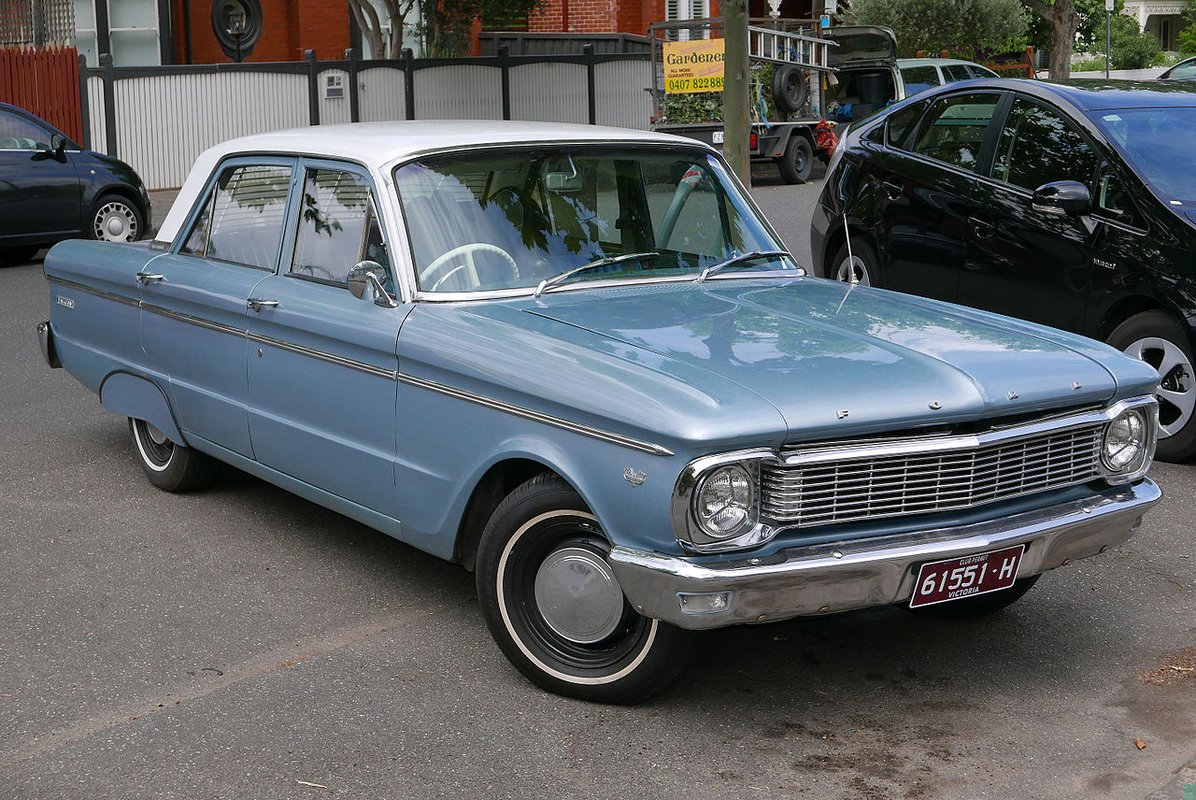
The Ford Falcon XK through XP series represents a pivotal moment in Australian automotive history, when Ford Australia finally delivered a genuinely local car built on Australian roads for Australian conditions. Launched in 1960, the original XK Falcon was a compact, affordable family car that quickly became the foundation of Ford's dominance in the local market throughout the decade. What made these early Falcons special wasn't flashiness, but solid engineering, good value, and a willingness to listen to what Australian drivers actually needed, from the rugged suspension geometry to the practical cabin layout.
These Falcons built their reputation through reliability and adaptability. They became favourites with everyday families, but also caught the attention of the performance crowd who recognised the potential in that straightforward engineering. The model's racing pedigree grew quickly, with Falcons proving competitive in touring car racing and establishing themselves as affordable platforms for serious drivers. By the time the XP arrived in 1965, the Falcon had evolved into something of a national icon, a car that Australians felt genuinely belonged to them rather than something imported and repackaged.
Today, these first-generation Falcons occupy a special place in the classic car scene. They're approachable, unpretentious machines that reward sympathetic ownership and represent a golden age when local manufacturing meant real engineering input and genuine market knowledge. Whether you're after a tidy family sedan or a potential project with racing history, the XK-XP Falcon remains a tangible connection to Australia's automotive heritage.
Thinking of buying a Falcon (XK-XP)?
What to look for, what to pay, what to avoid.
What to watch for.
Floor Pan Corrosion
Critical Rust (The Big One)
Floor Pan Corrosion
CriticalVisible rust perforation on the underside of the floor. Soft, spongy metal when prodded. In severe cases, daylight visible through the cabin floor.
Water enters the cabin through deteriorated door seals, windscreen rubber, and the firewall. Road spray attacks from below. Australian conditions, heat, humidity in the north, salt air on the coast, accelerate the process. Sixty years of moisture exposure is devastating to untreated mild steel.
Minor surface rust can be treated with rust converter and sealed. Perforated panels must be cut out and replaced. Reproduction floor pan sections are available from early Falcon specialists, though supply is inconsistent. A full floor pan replacement is a major undertaking, budget $2,000-6,000 depending on extent.
Sill (Rocker Panel) Rot
Critical Rust (The Big One)
Sill (Rocker Panel) Rot
CriticalBubbling paint along the lower body sides, soft metal when prodded, visible perforation.
The sills are enclosed box sections. Water enters through door drain holes, condenses inside the box, and has nowhere to go. The sills rot from the inside out, so by the time you see exterior evidence, the internal damage is extensive.
Cut out the damaged sections and weld in new metal. Reproduction sill sections are available. This is skilled panel work, not a DIY job for most owners. Budget $1,500-3,000 per side for a proper repair.
Boot Floor and Spare Tyre Well
Common Rust (The Big One)
Boot Floor and Spare Tyre Well
CommonRust in the boot floor, water pooling in the spare tyre well, perforation around the tail-light mounting points.
Tail-light gaskets perish and admit water. The boot lid seal deteriorates. Water collects in the spare tyre well, which has no drain, and sits against bare metal. The boot floor is one of the first areas to rust on early Falcons.
Repair sections are available. Lift the boot mat on any car you're inspecting and check meticulously. Budget $800-1,500 for a boot floor repair.
Lower Quarter Panels
Common Rust (The Big One)
Lower Quarter Panels
CommonBubbling, blistering, or perforation on the lower rear quarter panels behind the rear wheels.
Road spray and mud collect between the inner and outer skins. The trapped moisture causes rust from the inside, invisible until it perforates the outer skin.
Cut and weld repair sections. On XP Hardtops, quarter panel repair is particularly expensive due to the complex body shape. Budget $1,000-2,500 per side.
Cooling System Inadequacy
Critical Engine: 144ci and 170ci Inline-Six
Cooling System Inadequacy
CriticalTemperature gauge climbs in slow traffic, on hot days, or when towing. The engine may boil over, pushing coolant out of the overflow.
The original cooling system was designed for 1960s driving conditions, predominantly open-road cruising. Australian summer temperatures combined with modern stop-start traffic overwhelm the system. A 60-year-old radiator is almost certainly partially blocked. The engine-driven fan only moves adequate air at highway rpm.
Have the radiator recored ($300-600) or fit an aluminium replacement ($400-800). Install an electric thermo fan for low-speed cooling. Replace the thermostat (they're cheap and old ones stick). Ensure the water pump is not cavitating or leaking. Flush the entire cooling system.
Worn Valve Guides
Critical Engine: 144ci and 170ci Inline-Six
Worn Valve Guides
CriticalBlue smoke on startup that clears after a few minutes. Increased oil consumption. In severe cases, blue smoke under all conditions.
The valve guides wear over decades of use, allowing the valve stems to rock in the guides. Oil runs down the stems and into the combustion chamber, where it burns as blue smoke.
The cylinder head needs to be removed and the valve guides replaced or reamed and fitted with oversize-stem valves. This is a machine shop job. Budget $600-1,200 for a complete head recondition including guides, valves, seats, and springs.
Join the conversation.
Common questions.
Overview
The Ford Falcon XK through XP (1960-1966) are the cars that launched Ford in Australia and ignited the rivalry with Holden that defined Australian motoring for half a century. These are the first Falcons, the Broadmeadows originals, and they generate plenty of questions from prospective buyers, new owners, and enthusiasts.
How do I tell the difference between an XK, XL, XM, and XP?
The quickest way to identify each model is the front end. **XK (1960-1962):** Horizontal chrome grille bars with a simple, clean design.
What's the difference between the 144ci and 170ci engines?
Both are members of Ford's overhead-valve inline-six family, sharing the same basic architecture. The **144 cubic inch (2.
Is the XK really just an American car with the steering wheel on the other side?
Largely, yes. The XK was based directly on the 1960 US Ford Falcon.
Own a Falcon (XK-XP)?
Share your car with the community. explore more Ford models.