Falcon (EA-AU)
1988-2002 / Sedan / Estate / Australia
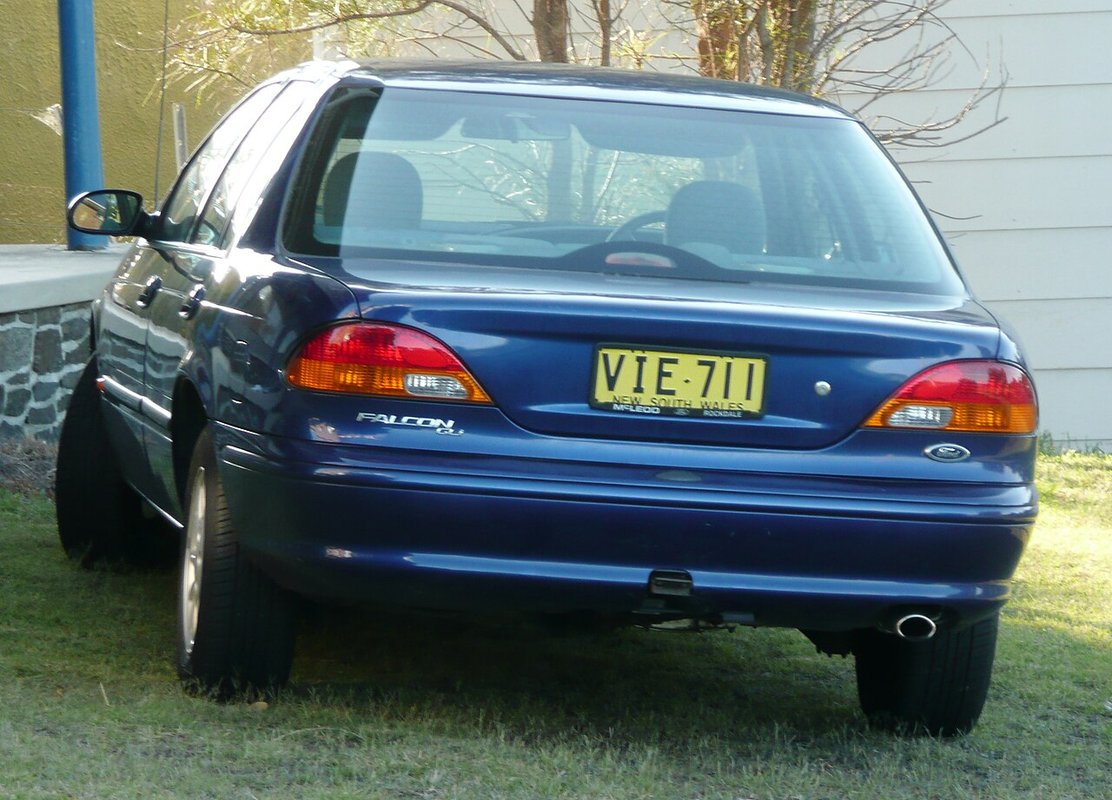
The EA to AU series Falcon represents a pivotal era for Ford Australia's iconic nameplate, spanning the late 1980s through early 2000s. Born from a fundamental redesign that moved away from the old Falcon formula, these generations embraced modern aerodynamics, improved safety standards, and more sophisticated engines while maintaining the car's essential character as Australia's volume family car and performance hero. The EA Falcon arrived in 1988 with a completely new platform, dropping the aging inline-six in favour of more contemporary powerplants, and the subsequent EB, ED, EF, EL, and AU variants continued the evolution with incremental refinements in technology, comfort, and driving dynamics.
These Falcons hold special significance in Australian automotive culture because they represented Ford's commitment to local manufacturing during a period of genuine market competition. They were everywhere on Australian roads, from family transport to police cars to Bathurst contenders, and that ubiquity has made them genuine classics in the community today. The later EB and EF models in particular gained cult status thanks to their involvement in touring car racing and the street performance scene, while the high-performance variants like the XR and later the FPV-developed models proved that Ford could still build genuinely quick cars at Broadmeade.
For enthusiasts, the EA-AU Falcons represent solid, unpretentious Australian engineering. They're straightforward to work on, parts remain accessible, and there's a genuine community of owners who understand these cars inside out. Whether you're drawn to a daily-driver Futura, a raw XR racer, or a immaculate original sedan, the EA-AU generation offers real driving engagement and authentic Australian automotive heritage without the stratospheric prices of earlier legends.
Thinking of buying a Falcon (EA-AU)?
What to look for, what to pay, what to avoid.
What to watch for.
TFI Module Failure (EA-ED)
Critical Engine
TFI Module Failure (EA-ED)
CriticalThe engine cuts out while driving and won't restart. After cooling for 30-60 minutes, it may restart and run normally for a while before dying again. Sometimes fails permanently.
The Thick Film Ignition (TFI) module is mounted on the distributor, directly exposed to engine heat. The module's internal solder joints crack from thermal cycling. This is a design flaw, the module should never have been heat-soak mounted. Bosch designed the unit; Ford Australia (via Motorcraft) just relabelled it.
Replace the TFI module. Genuine Motorcraft units are the most reliable but increasingly hard to find. Aftermarket Bosch units are available ($80-150). Some owners relocate the TFI module away from the engine using an extension harness to reduce heat exposure. Carry a spare in the glovebox, this is the number one stranding failure on EA-ED Falcons.
Hydraulic Lifter Tick (AU especially, all models)
Common Engine
Hydraulic Lifter Tick (AU especially, all models)
CommonA ticking or tapping noise from the top of the engine, often worst on cold start. May persist for minutes or be constant. The noise comes from the rocker cover area.
The hydraulic lash adjusters (HLAs) wear internally and lose their ability to maintain zero valve lash. Oil quality and change intervals directly affect lifter life. The AU seems most susceptible, though all SOHC Falcons can develop this issue at high mileage.
Replace all 12 lifters. The job requires removing the rocker assembly, unbolt the rocker shaft pedestals evenly (one turn at a time, outside to centre), remove the assembly, and use a pin punch and small hammer to tap out each lifter. Install new lifters greased on the outside, with the shim slot facing upward (oil feed). Reassemble centre to outside, torque pedestal bolts to 22 Nm. The job takes 4-6 hours. Parts: $180-250 from aftermarket suppliers. Ford charges $82 each ($984 for a set).
Coil Pack Failure (EF-EL)
Common Engine
Coil Pack Failure (EF-EL)
CommonMisfiring on specific cylinders, rough idle, loss of power. May be intermittent initially, then become constant.
The EF and EL use a waste-spark coil pack (three coils firing six cylinders). Heat and age cause internal insulation breakdown in individual coil towers.
Replace the coil pack. Use new spark plug leads at the same time, old leads can damage a new coil pack through increased resistance. Cost: $100-200 for the coil pack, $50-80 for leads.
Crank Angle Sensor Failure (EA-ED)
Critical Engine
Crank Angle Sensor Failure (EA-ED)
CriticalEngine cranks but won't start, or starts and dies. No spark at all cylinders.
The crank angle sensor (CAS) on EA-ED models is located in the distributor. The sensor's magnetic pickup weakens with age, or the toothed reluctor wheel develops corrosion.
Replace the crank angle sensor. On EA-ED, this requires partially disassembling the distributor. Set timing to top dead centre (TDC) on cylinder #1 before removing the distributor. When reinstalling, ensure the rotor points to the #1 lead position. Cost: $60-120.
Idle Speed Control (ISC) Valve Issues
Common Engine
Idle Speed Control (ISC) Valve Issues
CommonErratic idle speed, high idle (1,500+ rpm), stalling when coming to a stop, or inability to maintain idle.
The ISC valve (also called the idle air control valve) clogs with carbon deposits from PCV system blowby. The valve is an electric stepper motor that controls idle air bypass.
Remove and clean the ISC valve with carburettor cleaner. Reset the base idle by: (1) Remove ISC plug, (2) Insert 0.75 mm feeler gauge between the throttle stop tab and throttle lever, (3) Put the engine in diagnostic mode, (4) Wait 2 minutes and adjust the throttle blade screw until idle reads 700 rpm (+/- 50). Cost: free if cleaning works; $80-150 for a new ISC valve.
Rocker Cover Bolt Breakage
Common Engine
Rocker Cover Bolt Breakage
CommonA rocker cover bolt snaps during routine maintenance, leaving the threaded portion stuck in the head.
The bolts are small and the aluminium head threads are soft. Over-torquing or corrosion causes the bolt to shear. Rocker cover bolt torque is 17 Nm, surprisingly light.
Use a screw extractor (easy-out) to remove the broken bolt. If the threads are damaged, a helicoil repair is necessary. Take extreme care during removal, if the broken bolt is forced and the thread strips, the head requires professional repair.
Join the conversation.
Common questions.
What is a Ford Falcon EA-AU?
The EA (1988-1991), EB (1991-1993), ED (1993-1994), EF (1994-1996), EL (1996-1998), and AU (1998-2002) are six generations of the Ford Falcon built at Ford's Broadmeadows plant in Melbourne, Victoria. All share a common platform lineage and the 4.
What engine does my Falcon have?
All EA-AU Falcons use a version of the Ford Australia inline-six: - **EA:** 3.9L (3,947 cc) SOHC, single-point or multipoint injection, 135-145 kW - **EB-ED:** 4.
What is the difference between the EF and EL?
The EL (1996-1998) is an evolution of the EF (1994-1996). Key differences: the EL has revised exterior styling (new headlights, taillights, bumpers), improved interior materials, a better-balanced crankshaft, and refined engine calibration.
What is Smartlock and why won't my car start?
Smartlock is Ford's engine immobiliser system, introduced on the EB Falcon. It uses a transponder chip in the ignition key that communicates with the Body Electronics Module (BEM).
Own a Falcon (EA-AU)?
Share your car with the community. explore more Ford models.