HK-HG Monaro / GTS
1968-1971 / Coupe / Australia
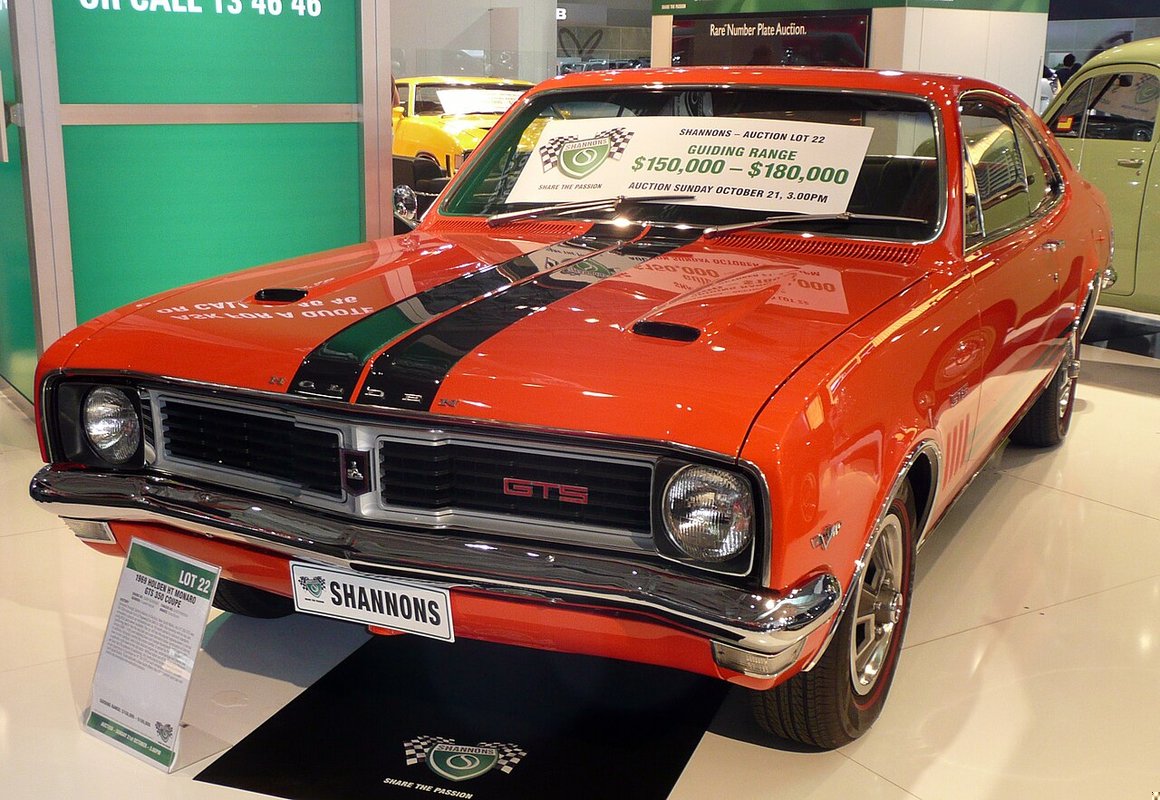
The HK-HG Monaro and GTS represent a golden era of Australian muscle car manufacturing, when Holden was producing genuinely competitive hardware that could mix it with the best international offerings. Launched in 1968, the Monaro was Holden's answer to the global pony car craze, a sleek fastback coupe that combined clean American-influenced styling with solid Aussie engineering. The GTS variant, arriving in 1970, cranked up the aggression with the legendary 5.0-litre V8 that produced a genuine 350 horsepower, making it one of the quickest Australian-built cars of the era.
These cars left an indelible mark on Australian motoring culture and remain beloved by enthusiasts today. On the track, Monaro GTS models proved themselves capable racers, competing fiercely in touring car championships and leaving rivals in their dust on the street. The combination of that potent V8, tight handling, and purposeful styling created something that Holden could genuinely be proud of, a car that didn't feel like a hand-me-down from Detroit but rather a distinctly Australian take on performance driving. Club scene popularity has remained strong, with good examples becoming increasingly sought-after as collectors recognize their historical importance and genuine driving appeal.
The HK-HG generation is notable for its durability and the strong community support that surrounds it. Original examples and well-restored specimens command respect at meets and shows, and the mechanical simplicity means these cars remain accessible and enjoyable to maintain and drive. For many, owning a Monaro or GTS represents a piece of Australian automotive confidence during a period when local manufacturing meant something genuine.
Thinking of buying a HK-HG Monaro / GTS?
What to look for, what to pay, what to avoid.
What to watch for.
Intake Manifold Gasket Leaks
Critical Engine, Chevrolet V8 (327ci / 350ci)
Intake Manifold Gasket Leaks
CriticalCoolant leak at the front or rear of the intake manifold. Coolant may drip externally or, worse, leak internally into the engine oil. May also cause a vacuum leak, resulting in rough idle and poor fuel economy.
The Chevrolet small-block V8 uses an intake manifold that seals to both the cylinder heads and the front/rear of the block (the "valley" area). The gaskets between the manifold and the block ends deteriorate with age and heat cycling. The RTV (silicone) sealer used in this area also fails over time.
Remove the intake manifold, clean all surfaces, and reinstall with new gaskets and fresh RTV sealer. This is a significant job but not technically difficult, the carburettor, distributor, and ancillaries must be removed to access the manifold bolts. Budget $200-400 for gaskets and a day's labour. Always check for coolant contamination in the oil (milky residue on the dipstick) before reassembly, if coolant has entered the oil, the engine should be flushed and the bearings inspected.
Rochester Quadrajet Carburettor Issues
Common Engine, Chevrolet V8 (327ci / 350ci)
Rochester Quadrajet Carburettor Issues
CommonHesitation on acceleration (bog), flooding, fuel smell, hard starting when hot, black smoke, erratic idle.
The Rochester Quadrajet (Q-jet) is a complex 4-barrel carburettor with small primary jets and large secondaries. The primary metering rods and jets wear, the accelerator pump deteriorates, the float level drifts, and the power piston can stick. The Q-jet's small primary circuits are sensitive to dirt and fuel quality. Ethanol in modern fuel attacks the original rubber accelerator pump and needle valve seat.
A full Q-jet rebuild with a quality rebuild kit ($80-150) addresses most issues. The key is getting the float level correct, an incorrect float level causes almost all Q-jet running problems. Alternatively, many owners replace the Q-jet with a Holley 4-barrel or Edelbrock Performer carburettor ($400-800). These are simpler to tune and maintain, though they're not period-correct for concours judging.
Overheating Under Load
Critical Engine, Chevrolet V8 (327ci / 350ci)
Overheating Under Load
CriticalTemperature gauge climbs on highway drives, particularly towing or climbing hills. May push coolant out the overflow. Engine pings (detonation) under load.
The 327 and 350 V8s generate significant heat, and the factory cooling system was designed for 1960s conditions. The original radiator may be partially blocked. The clutch fan loses efficiency with age. The thermostat may be stuck or the wrong rating. In the Monaro's engine bay, heat soak from the exhaust manifolds further stresses the cooling system.
Have the radiator recored or replaced with a 3-core brass or aluminium unit ($400-800). Fit an electric thermo fan ($150-250). Ensure the thermostat is 82°C (180°F) and functioning. Check the water pump for leaks and cavitation. Consider ceramic-coated or wrapped exhaust manifolds to reduce underbonnet heat.
Hydraulic Lifter Noise
Common Engine, Chevrolet V8 (327ci / 350ci)
Hydraulic Lifter Noise
CommonTicking or clattering from the top of the engine that varies with RPM. May be audible at idle and disappear at higher RPM, or vice versa.
The Chevrolet small-block uses hydraulic lifters that compensate for valve train clearance changes as the engine heats up. Over time, the lifters wear internally, develop internal leaks, or collapse. Dirty or old oil exacerbates the problem, the lifters rely on clean oil to maintain pressure.
Start with an oil change using quality 15W-40 or 10W-40 and a can of engine flush. If the ticking persists, individual lifters can be replaced. Budget $10-20 per lifter, and there are 16 of them. Replacing all 16 is recommended, if one has failed, the others are wearing. Access requires removing the intake manifold, rocker arms, and pushrods. Budget a full day's labour.
Oil Leaks, Rear Main Seal
Common Engine, Holden Six (186ci) and V8 (253ci)
Oil Leaks, Rear Main Seal
CommonOil drips from the bellhousing area. Oil accumulates on the underside of the engine and transmission.
The Holden six and 253 V8 use a rope-style rear main seal that hardens with age. Every old Holden engine leaks from the rear main seal to some degree.
Replace the rear main seal. Requires engine or gearbox removal. Budget $500-1,000 at a workshop. Many owners tolerate a slow leak and keep the oil topped up.
Valve Train Wear (253 V8)
Common Engine, Holden Six (186ci) and V8 (253ci)
Valve Train Wear (253 V8)
CommonTicking or clattering from the top of the engine. Reduced power.
The Holden 253 V8 uses adjustable rocker arms on a shared shaft. The rocker tips and shaft wear with age, particularly if the rockers haven't been adjusted regularly.
Inspect and replace worn rockers and shaft. A Yella Terra roller rocker conversion ($400-800) eliminates the wear issue permanently and adds a useful amount of top-end power.
Join the conversation.
Common questions.
What's the difference between the HK, HT, and HG Monaro?
The HK (1968-1969) was the original, introducing the pillarless coupe body and the GTS 327 package. The HT (1969-1970) refined the package and introduced the Chevrolet 350 V8, the engine that became the Monaro's defining powerplant.
What engines were available?
The engine range across the three series included: the 186ci (3,048 cc) Holden six (~115 hp), the 253ci (4,146 cc) Holden V8 (~185 hp), the 307ci (5,031 cc) Chevrolet V8 (~200 hp, HK only), the 327ci (5,359 cc) Chevrolet V8 (~250 hp), and the 350ci (5,733 cc) Chevrolet V8 (~300 hp, HT and HG only). The GTS package was available with the 327 (HK) and 350 (HT, HG).
What makes the GTS so special?
The GTS (Gran Turismo Sport) was the full performance package, the engine, the suspension, the brakes, the interior, and the attitude. A GTS 327 or GTS 350 came with bucket seats, full instrumentation, a floor-shift manual or heavy-duty automatic, front disc brakes, performance-tuned suspension, rally wheels, body stripes, and the most powerful engine available.
How much is a Monaro worth?
It depends entirely on the variant. A six-cylinder Monaro coupe in project condition starts around $20,000-35,000.
Own a HK-HG Monaro / GTS?
Share your car with the community. explore more Holden models.